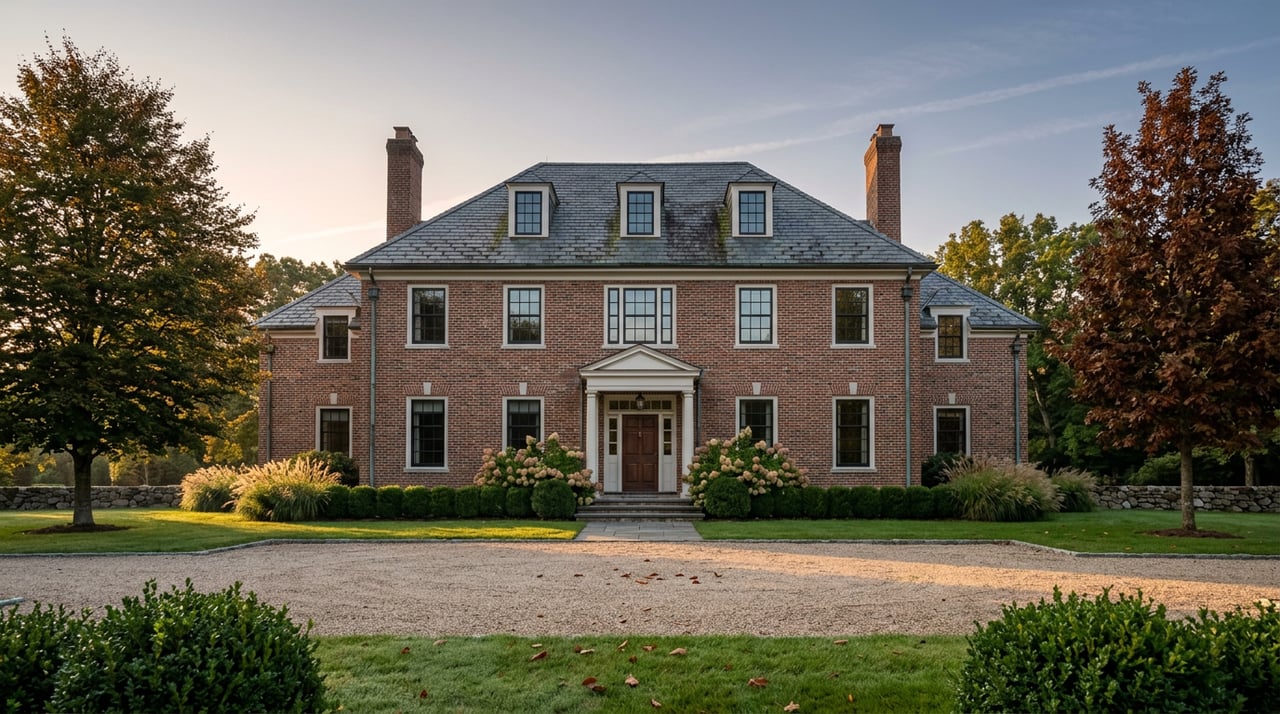
Park at the Muttontown Lane entrance on a Saturday morning and you will likely see strollers, dog leashes, and a family or two heading toward a stone mansion with a manicured lawn out front. Park a mile and a half away off Route 106, at the entrance most people call the equestrian lot, and you will find a dirt pull-off, no bathroom, and a trail that disappears into brush within a few hundred feet. Both are Muttontown Preserve. Neither prepares you for the other.
That split reflects the preserve's history as three separate estates brought together decades ago. Signage is inconsistent in places, adding to the contrast between the entrances. If you live in Muttontown and only know the preserve from one entrance, you have only seen half the story sitting inside your own village.
Three Estates, One Name
Muttontown Preserve covers 550 acres, making it the largest nature preserve in Nassau County, according to the county's own parks department. But that single number covers three parcels with three separate histories. A section came from Alexandra Moore McKay, wife of the village's first mayor, and it includes the nature center and Chelsea Mansion. A much larger section was purchased from the estate of businessman Lansdell Christie, and this is the wilder half, home to the ruins most hikers come looking for. A smaller parcel donated by Mrs. Paul Hammond still shows physical evidence of the pre-Revolutionary Duryea Farm, tucked into a corner most visitors never reach.
The county folded these three parcels under a single name and a single trail map. Each section has a distinct maintenance history. The McKay section was cared for as a public estate from the start, complete with a mansion kept in good enough condition to host tours and private events. The Christie section had a very different fate.
The Manicured Half
Enter from Muttontown Lane, off Route 25A, and you land in the part of the preserve built for visitors. This is where the nature center sits, and where Chelsea Mansion still stands, a residence associated with the McKay family and listed on the National Register of Historic Places. The Chelsea Loop trail here runs about 1.9 miles and is flat and wide enough to work with a stroller. Elsewhere in this section stands Nassau Hall, designed in 1904 in a style meant to echo Mount Vernon and built for attorney Bronson Winthrop. Both structures reflect the same period of Gold Coast estate building that gave Long Island's North Shore its reputation, back when Wall Street money turned old farmland into private compounds with imported stone and formal gardens.
Trail posts are numbered, and paths are cleared. If you have twenty minutes and a stroller, this is your route.
The Wild Half
The Christie parcel tells a different story, and it centers on the ruins of the Knollwood Estate, once the property of a deposed European monarch.
The mansion itself was built in the early 1900s for Charles Hudson, a Wall Street investor, and it was an enormous structure, sixty rooms of granite. In 1951, Albania's exiled King Zog I bought the 150-acre Knollwood Estate, having fled his country after the Italian invasion of 1939 and spent the intervening years in England, Egypt, and France. Zog never moved in. He sold the property in 1955 to Lansdell Christie, and rumors quickly spread that he had hidden riches somewhere in the mansion's walls before leaving. Those rumors brought vandals, and vandalism brought enough damage that the Christie family had the mansion torn down in 1959.
What remains is what you find today: broken staircases, a walled garden, stone foundations swallowed by vines. Because this section was never rebuilt or formally landscaped after the demolition, it was simply absorbed into the preserve as raw acreage rather than restored parkland. That distinction explains most of the complaints you will find from first-time visitors, that the trails here lack consistent markers, that the map on your phone does not always match the signs on the ground, that a wrong turn can add half a mile before you realize it.
The AllTrails route through this section, often called King Zog's Loop, covers about 4.4 miles and takes close to two hours at an easy pace. Expect some soggy footing after rain, since several low points hold water for days. If your goal is the ruins specifically and you want the shortest route, the Route 106 equestrian lot gets you there faster than starting from the nature center side, though you should plan on some backtracking regardless. Bring a downloaded map rather than relying on cell service once you're in the trees.
Why Fall Is the Window Worth Using
September and October are the peak migration months in the preserve, when songbirds pass through in numbers and hawks become easier to spot overhead, according to naturalist notes distributed by the county. Combine that with the color turning in the oak-hickory canopy that covers most of the property, and the next several weeks are the strongest stretch of the year to walk either half of the preserve. The wetlands and vernal ponds that stay quiet in summer start drawing more visible wildlife activity as temperatures drop.
There is also a physical change coming to the property. A 2024 climate-resilience grant funded invasive vine removal around the Knollwood walled garden, with plans to rebuild it as pollinator habitat, and an ADA-accessible boardwalk over one of the wetland areas has been in planning for this year. If you have not been out to the ruins recently, it is worth checking before your next visit whether that work has changed access in that corner of the preserve.
For residents who want a more regular connection to the place rather than an occasional weekend walk, a volunteer group known as Friends of Muttontown Preserve runs monthly cleanups, informal enough that they end with donuts rather than a program. It is a low-effort way to know the preserve as more than a place you drive past.
A Preserve Worth Knowing in Full
Most people who live near Muttontown Preserve settle into one entrance and one version of it. The nature-center crowd rarely makes it to the ruins. The ruins crowd sometimes never realizes there is a mansion open for tours a mile away. Both halves are free, open year-round, and require no permit, so there is no real reason to only know one of them.
The next few weeks of foliage and migration are as good a reason as any to see the other half of your own preserve. Bring good shoes, download a trail map before you lose signal, and give yourself more time than the mileage suggests, especially if the ruins are your destination.
For more on the history behind Muttontown's estates and their place in the North Shore's Gold Coast story, Nassau County's parks department keeps a short history on file, and AllTrails has current trail conditions and recent hiker reports if you want to check the ground situation before you go.
If you are curious about what else makes this part of the North Shore worth calling home, or simply want to talk through the neighborhood with someone who has walked its trails and knows its history, Gwen Levy is always glad to connect.